Friday, September 9, 2016

IELTS Materials and Resources, Get IELTS Tips, Tricks & Practice Test

IELTS Materials and Resources, Get IELTS Tips, Tricks & Practice Test


IELTS Writing Practice Test 6 From Recent Test (12/12/2015)

Posted: 09 Sep 2016 03:00 AM PDT

IELTS Writing Task 2 Topic:

People should follow the customs and traditions when people start to live in a new country. To what extent do you agree or disagree?

Outline

Identifying the essay type: Agree or disagree 
Structuring the essay:

INTRODUCTION:

many people hold this opinion. I completely agree with it.

BODY

Paragraph 1: [Problems if local customs are not followed]

[1] Difficulties for new residents who do not follow customs and traditions of host country -example: if they start a business, they have to know local business customs in order to be successful.

[2] Some actions will be illegal in the host country and will make local people angry, too -example: Singapore.

Paragraph 2: [Benefits of following local customs and traditions]

[1] Local people will accept newcomers who do this – more integration, easier to make friends.

[2] New immigrants will enjoy the traditions and be able to take part in community life -example: enjoy festivals.

CONCLUSION: 

repeat, using some different words.

BAND 8.0+ SAMPLE ANSWER:

Many people argue that foreigners should adapt to the local customs and traditions when they come to reside in a new country. I completely agree with this view.

Newcomers will certainly face difficulties if they do not conform to the norms of social behaviour in the host country. Firstly, it will become almost impossible for them to blend into their new environment. For example, an entrepreneur who comes to live in a new country and starts up a business must be aware of the business practices of that country. There are bound to be many pitfalls, not only legal ones but also simply in terms of winning and keeping customers. Secondly, recent immigrants might fall foul of the law if they do not respect the behaviour and customs of locals. In Singapore, for instance, residents will consider newcomers dirty and ill-mannered if they litter the street or spit gum in public places.

There are also many benefits for foreigners when they do adopt the customs and traditions of their new country of residence. One advantage is that local people will be more welcoming when they feel that the newcomers are showing respect for the local way of life. The establishment of closer links with the host community might lead to greater integration and mutual understanding. Another benefit is the richness of the experience which newcomers will gain from enjoying aspects of local customs and traditions, enabling them to participate in community life and avoid social isolation. During festivals and national holidays, especially, they will feel like they 'belong' in their new country.

In conclusion, I would argue that it is essential for new residents to follow the traditions and habits of locals in the host community in order to integrate fully into society.

(293 words)

Useful vocabulary

  • The norms of social behaviour: standards of behaviours that are typical of and accepted within society
  • Host country
  • Blend into
  • An entrepreneur
  • Bound to (be)
  • Pitfalls
  • Fall foul of the law
  • Newcomers
  • Integration
  • Mutual understanding
  • Social isolation

Hope you can find this post intriguing. Try to practice writing every day to improve your writing skills. You can find more tips and lessons about the IELTS test on ieltsmaterial.com. Don’t forget “Practice makes perfect”.

On A Knife Edge – Idiom Of The Day For IELTS

Posted: 09 Sep 2016 01:00 AM PDT

On A Knife Edge – Idiom Of The Day For IELTS Speaking.

Definition: 

In a very difficult situation and there are worries about the future.

Example:

“I’ve put myself on a knife edge when I forgot the calculator in the business management qualification test, which involved a lot of calculations.”

“These underprivileged families have to live on a knife edge because their houses are demolished by the storm.”

“At that time, she stood on a knife edge when the bank declared her that her own company was bankrupt.”

Exercise: 

  1. The sentence given below contains an idiom. From the given alternatives, choose the one that best expresses the meaning of this idiom.
    “When Ben sold his house for his investment, he obviously put himself on a knife edge.”
    A. He needed a knife.
    B. He wanted to go somewhere.
    C. He was satisfied with his decision.
    D. He put himself at risk.
  2. Describe the time when you was in the dangerous situation. Try to use this idiom in your speech. You should say:
    – When did it happen ?
    – What did you do during this time ?
    – How did you escape from the situation ?
    – And do you learn any lesson from this ?

Principle – Word Of The Day For IELTS

Posted: 09 Sep 2016 01:00 AM PDT

Principle – Word Of The Day For IELTS Speaking And Writing

Principle: (Noun) /ˈprɪnsɪp(ə)l/

Definition:

The basic idea that a plan or system is based on

Synonyms: 

Assumption, Precept, Doctrine

Collocations: 

With adjective: basic/ democratic/ fundamental/ general/ guiding/ important/ legal/ moral principle
With verb: accept/ adhere/ agree/ apply/ based/ establish/ follow/ guide/ stick/ understand principle
With preposition: principle of/that/behind

Example:

For IELTS Speaking:
“The project worked on the principle that each person’s experience was equally valuable.”
“Reflexology is based on the principle that specific areas on the feet correspond to different parts of the body.”

For IELTS Writing:
“The general principle is that education should be available to all children up to the age of 16.”

Exercise:

Choose the following words to fill in the blank: interpret, specific, data, formulas, principles, concept, major, area, role, establish.

  1. The _______________ of an arranged marriage is almost totally unknown in this country.
  2. The police have not yet been able to _______________ the cause of death for a man who was found floating in the river.
  3. The country covers a total _______________ of over 1,725 square kilometres.
  4. Jefferson has a largely defensive _______________ to play on the team, and is not known for scoring.
  5. We need an accountant to _______________ our financial statements.
  6. Under the Soviet system, the economy of Georgia was run on socialist _______________, such as public ownership of the means of production.
  7. Gasoline has no _______________ freezing point; it freezes at any temperature between -180 and -240 degrees Fahrenheit.
  8. We had to memorize about 20 different _______________ for the math test.
  9. The world’s _______________ rainforests are located in South and Central America, and in South-east Asia.
  10. Heinrich W. Brandes made the first weather map in 1815, based on _______________ gathered in 1783.

Answer key
1. concept.
2. establish.
3. area.
4. role.
5. interpret.
6. principle.
7. specific.
8. formulas.
9. major.
10. data.

Check out Vocabulary for IELTS Speaking & Writing on IELTS Material website to improve your vocabulary for IELTS and get a high score in IELTS.

IELTS Cue Card Sample 30 – Topic: a street that you like to visit

Posted: 09 Sep 2016 12:51 AM PDT

IELTS Cue Card for IELTS Speaking Part 2:

Describe a street that you like to visit./Describe what you would do if you had a day off, free from work or study.

Describe a street that you like to visit

You should say:
where is it
how often you go there
what you usually do there
and explain why you like to go there

Describe what you would do if you had a day off, free from work or study.
You should say:
where you would go
what you would do there
who you would go with
and explain how you think you would feel at the end of this day.

BAND 9.0 MODEL ANSWER: 
As a full time employee/student, I don‟t have much free time. As a result, whenever I have a day off, I visit my favorite street in the city. The name of the street is [….]. It is located near [……] and it is the place where I would always choose to go. I usually go there in the morning, park my moped in the nearby parking lot and walk along the street by myself.

Although I am quite a sociable person, I like my own space from time to time. Living in a metropolitan area with a fast-paced life doesn‟t allow me to have time for myself that often. This is probably the only time I can escape from my normal routine, completely free and just breathe, without worrying about my job/my studies. This street is perfect for my purpose because there are only government offices around here, hence it is always quiet. Moreover, both side of the streets are planted with many big trees, their shade covers the whole street. On a sunny day, you can see the sun‟s rays shining through the leaves.

Every time I come here I feel fresh and less stressed, especially after my busy days at work/ preparing for exams. At the end of the day, I can refresh my mind and be ready for a new day.

VOCABULARY
moped: [noun] a motorcycle with a small engine and also pedals. Example: I sometimes use the engine on my moped, but more often I use the pedals, like a bicycle.
sociable: [adjective] a sociable person is someone who enjoys spending time with other people. Example: she's a sociable child who will talk to anyone.
my own space: my freedom and time to think and do what I want. Example: he was tired of being with other people, so he went to his room to get some space.
metropolitan: [adjective] connected with a large city. Example: my brother lives in the New York metropolitan area.
fast-paced: [adjective] very busy Example: my university course is very fast-paced, so it is difficult to complete all my
assignments on time.
shade: [noun] an area that is dark and cool under or behind something [like a tree], where the light of the sun does not reach it.
Example: We sat down in the shade of the wall.
rays: [noun] narrow lines of light. Example: The rays of the sun entered my window when the sun rose early in the morning.
refresh: [verb] to refresh somebody is to make them less tired or less hot. Example: A cool shower refreshed me after running in the park.

IELTS Listening Practice Test 35

Posted: 08 Sep 2016 11:20 PM PDT

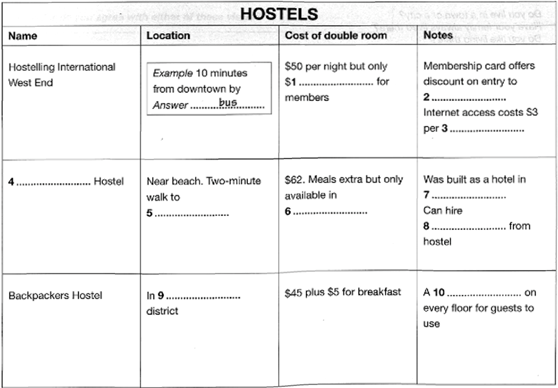
Section 1: Questions 1-10

Questions 1-10: Complete the table below. Write ONE WORD AND/OR A NUMBER for each answer.

IElts listening practice test 35 - 3

Section 2: Questions 11-20

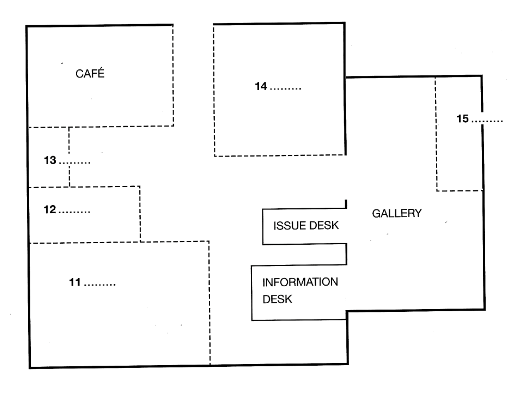
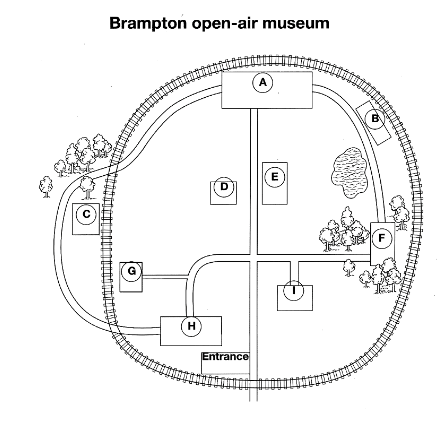
Questions 11-15: Label the map below. Choose FIVE answers from the box and write the correct letter A-H next to questions 11-15.
A biography
B fiction
C magazines
D newspapers
E non-fiction
F photocopiers
G reference books
H study area

IElts listening practice test 35 - 2

Questions 16-20: Choose the correct letter, A. Bor C.
16. After two years, library members have to ………………
A. show proof of their current address.
B. pay for a new membership card.
C. bring a passport or identity card into the library.
17. What happens if you reserve a book?
A. It will be available after five days.
B. You can collect It a week later.
C. You will be contacted when it is available.
18. Which materials can be borrowed for one week only?
A. some reference books
B. CD-ROMs
C. children's DVDs
19. On which day does the library stay open later than it used to?
A. Wednesday
B. Saturday
C. Sunday
20. Large bags should be left on the ………………
A. first floor.
B. second floor.
C. third floor.

Section 3: Question 21 – 30

Questions 21-25: Choose the correct letter, A. B or C.
21. Why did Anita and Lee choose to talk about John Chapman?
A. He was Lee's childhood hero.
B. They wanted to talk about the USA.
C. He was relevant to the topic of their studies.
22. Where did the students record their sources of information?
A. on their laptops
B. on a handout
C. on a database
23. The tutor claims she does not understand whether ……………..
A. apples grew in America before Europeans arrived.
B. the Native Americans had always eaten apples.
C. American apples were first bred in Europe.
24. The tutor says the audience was particularly interested to hear about …………….
A. grafting techniques in ancient China.
B. the cultivation of apples in Kazakhstan.
C. the spread of apples along the Silk Route.
25. How will Anita and Lee present their follow-up work?
A. on the department website
B. as a paper
C. as a poster
Questions 26-30: What do Lee and Anita agree about their presentation skills with their tutor?
Write the correct letter A, B or C next to questions 26-30.
A. excellent
B. acceptable
C. poor
Presentation skills
26. use of equipment
27. handling software
28. timing of sections
29. design of handout
30. clarity of speech

Section 4: Questions 31-40

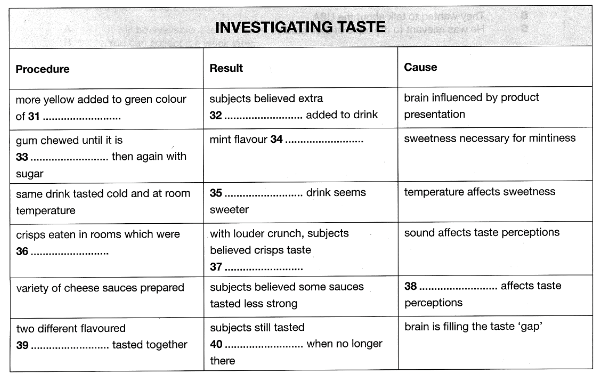
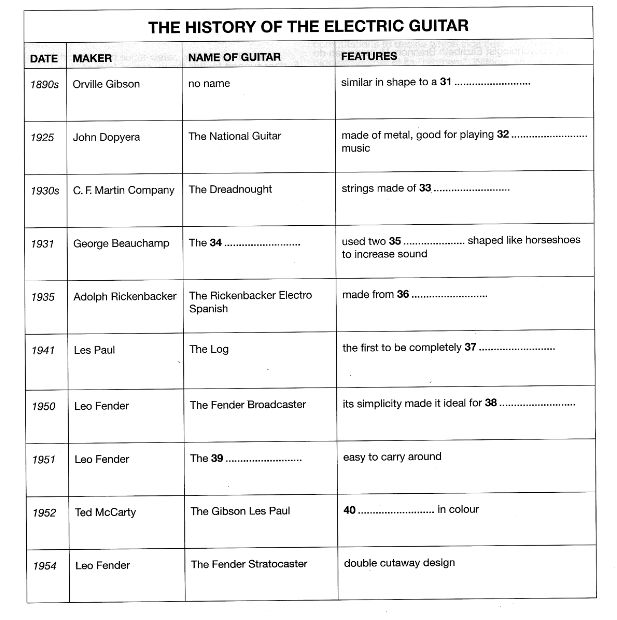
Questions 31- 40: Complete the table below. Write NO MORE THAN ONE WORD for each answer.

IElts listening practice test 35 - 3

ANSWER KEY
1. 41
2. museums
3. hour
4. Elliscoat
5. ferry
6. summer
7. 1887
8. scooter(s)
9. entertainment
10. kitchen
11. B
12. H
13. C
14. E
15. A
16. A
17. C
18. C
19. B
20. B
21. C
22. B
23. A
24. C
25. A
26. A
27. B
28. C
29. B
30. A
31. cans
32. lime
33. tasteless
34. returns
35. warm
36. soundproofed
37. fresher
38. texture / thickness
39. liquids
40. strawberry


TRANSCRIPT FOR IELTS LISTENING PRACTICE TEST 35

LISTENING SECTION 1

Man: Good morning. Can I help you?

Woman: I hope so! I have a friend in Spain and her two daughters are coming to the city to study for a month. So I thought the Tourist Information Centre was the best place to ask about hostels. Can you recommend any?

Man: Of course. Ah, I usually suggest one of the Hostelling International places. HI West End is a big hostel in a residential area, but it's only ten minutes from downtown if you take a bus. It's really popular.

Woman: OK. Sounds good! I need to know how much it costs. The girls want a double room to themselves. They don't want to share with other people.

Man: That makes it more expensive. The price is under $30 for a bed in a dormitory but they'll be paying $50 a night. But if they become members of Hostelling International, the price comes down to $41 a night. Membership costs $35.

Woman: Right.

Man: And membership offers them benefits too on all kinds of activities.

Woman: Ah, what kind of things?

Man: Oh, er, skydiving and white-water rafting. Things like that.

Woman: Mm, I don't think they're interested in that kind of thing.

If they become members, will they get cheaper entrance tickets to museums?

Man: Oh, yes and also discounts on bicycle and car hire.

Woman: OK. It's probably worth it. Is the hostel very noisy? They're coming here to do some studying.

Man: Ah, I think it is quite noisy as it's a really big hostel. And if they want to use the Internet this hostel still makes a charge unfortunately. It's $1 for 15 minutes and $3 for an hour.

Woman: Mm … it might not be ideal for them. What else can you recommend? Is there anything in a quiet area?

Man: There's Elliscoat Hostel.

Woman: Mm, how do you spell that?

Man: E-L-L-I-S-C-O-A-T.

Woman: I've never heard that name before. And where is that?

Man: It's on the beach looking over the bay. Here, look on the map. It's quiet but not far from Dragon Island – there's plenty going on there in the evening.

Woman: Oh, that's a nice area. And if they want to go to Dragon Island it only takes a couple of minutes to walk down to the ferry. So how much is a room there?

Man: It's in such a nice spot that the rooms are a bit more expensive. They're $62.

Woman: Does that include any meals?

Man: Unfortunately not. It is possible to buy meals in the hostel at a reasonable price but because it isn't very busy in the winter, they only cook in summer.

Woman: Oh, I think I know the place you mean. It's an old building, isn't it?

Man: Yes, it's well known as it's one of the oldest in the city.

There's been a hotel there since 1887 when it was first built.

It was turned into a hostel in 1985 and they've invested a lot of money restoring it inside.

Woman: Mm, they'd like that but I'm just looking on the map at where their college is – it's right in the centre. It is a bit far for them from there.

Man: The hostel actually has scooters for hire at a very good price. So they could do that. Er, it would be quicker than cycling or walking to the centre.

Woman: Mm, it is a bit expensive … But it sounds like the best one so far unless there's something a bit cheaper?

Man: OK. Er, well, what about the Backpackers Hostel? That's not so expensive. It's in a side street in the entertainment district. They wouldn't need to go far to find everything they want – they could walk everywhere. And it's very reasonable. Only $45 and another $5 if they want to have breakfast.

Woman: Mm, but what about other meals?

Man: There's no café but on each floor in this hostel there's a kitchen for residents to cook in. I'm not sure how well equipped they are but it should be fine for basic meals.

Woman: Well, that's really very helpful. I'll pass all this information on now. .

Man: Do ask your friends to ring me if they need to know anything else.

Woman: I will. Thank you.


LISTENING SECTION 2

Welcome to the Selmore Public Library which has just been reopened after major refurbishment. This tour will introduce you to the building and its services. At any time you can stop the tour. We enter by the café and our tour begins at the issue desk.

If you stand between the information desk and the issue desk and look at the opposite wall, you will see shelves of books in the left-hand corner. This is where vou will find a large number of novels and short stories. They are arranged alphabetically. If you're looking for something in particular and it's not on the shelf you can reserve it. The next area, directly opposite the issue desk, is a section where people can study. The library provides computers for users free of charge on the next floor beside the reference books but this area is for people to use their own laptops. You should ask for the internet passcode at the information desk.

In the right-hand corner of this floor there is a café. A selection of daily newspapers is always available there but you can also take magazines into the café to read while you have a drink. You will find these on the racks to the left of the café and there is a large selection. They are for reference only and cannot be borrowed but you are welcome to photocopy any articles of interest. We ask you to,return them when you have finished. You are not allowed to take fiction or any other books from the shelves into the café.

Next to the café is the exit door leading to the stairs and escalator to the other floors. The largest collection of books in the library is fiction and the next largest is nonfiction which is in the corner of this floor opposite the café. These can all be borrowed as opposed to the reference books on the next floor, most of which cannot be taken out of the library – but they can be photocopied. There are several photocopiers available for this purpose downstairs in the basement. To one side of the issue desk is a door leading onto a gallery. This was added to the library as a public space where talks are given once a week on a Saturday by visiting authors of both fiction and non-fiction. It also houses the biography section. There are notices advertising the talks in the study area.

Any books that you want to borrow should be taken to the issue desk. Before we leave this floor I will give you some information about using the library. There are also helpful notices by the information desk.

To join the library and take books out, you need a membership card. Take your passport or identity card, as well as proof of your home address, to the information desk and you will be issued with a card. After a period of two years, all readers are required to go to the desk with a document that has their name and current address on it so the library can keep up-to-date records of where people are living. There's no need to show a passport again and there is no charge for this but any lost cards are charged at £5.

If you can't find the book you want on the shelves, you can reserve it. If it's in another library in the city, we can usually get it for you within a week. If someone else has borrowed it, it can take a few weeks. Either wav, we notify vou bv phone or email when the item is available to be picked up. We will hold it for you for five days.

Books can be borrowed for fourteen days and can be renewed for a further two weeks. Children's books also have a two-week borrowing period. The same system exists for CD-ROMs and CDs but DVDs, both children's and adults', can only be borrowed for UP to seven davs. It isn't possible to renew them. Some reference books can be borrowed but normally only for one day, so 24 hours.

The library opening hours have been changed slightly. Instead of opening late on Wednesday evenings till 8pm, we will be closing at 6, as on other weekdays, but we will close at 7 instead of 5.30 on Saturdays and – a new development – we are going to open on Sunday mornings from next month – 9 to 1. We are closed on public holidays and notices are posted in the library about these.

Before you go upstairs, please note that if you are going to the exhibition area on the third floor, large bags are not allowed.

There are lockers beside the reference area on the second floor where vou can deposit them. If you need change, you can get that from the information desk on the first floor.

Now press 'pause' and proceed to the second floor. When you reach the top of the stairs press 'play'.

LISTENING SECTION 3

Tutor: Well, Anita and Lee. That was an interesting presentation you made about John Chapman. There are a few points I'd like to run through before you write it up. One thing which you didn't explain was why you decided to do a presentation on this man who spread apple varieties across the US?

Anita: Well, ages ago, we were chatting about stuff we'd read as children, and I told Lee the Johnny Appleseed story – I had these American story books when I was small. Then when we were looking into the area of domesticated species of plants for our presentation, we realised that the introduction of the apple with the settlers in the US would be a good case study …

Lee: And I remembered Chapman, so we looked up the real guy behind the legend.

Tutor. Right. I think that would have made a good Intro.

Anita: I thought it was too personal.

Tutor: Just a couple of minutes would have drawn your listeners in. Anyway. Now a more serious point. You didn’t mention the sources of some of your information.

Lee: We used some books and journal articles and did an internet search and found some good sites.

Anita: We’ve put them on the back of the handout we gave everyone at the end.

Tutor: Ah, let me see. Oh. here it is. Johnny Appleseed: Man and Myth, 1967. Well, the thing is. you really have to make this explicit when you talk. And anything you show, data you project from your laptop, etc., you must have the source on it.

Anita: Right, OK.

Tutor: At least you have got it all documented. I was a bit concerned about that.

Anita: Sorry.

Tutor. Anyway. Now, the content of your talk What vour listeners wanted to understand was whether, there were apples in the US before the Europeans started to live there. You told us the early settlers had brought young apple trees but that few of them had thrived because the climate was harsh, but what about native species? I don’t think you were very clear about species already there.

Lee: Um, according to what I’ve read, there were some crab apples, but that was all. Everything that people now think of as traditional American apples, were species that the Europeans either introduced or bred by chance.

Anita: Because they tended to sow seeds rather than use grafting.

Tutor Yes, quite. But what to me was fascinating – and I saw most members of your audience start to take notes – was when you discussed how the apple genes spread via the Silk Route into Europe from the wild apple woods of Kazakhstan.

Lee: Yes, well. I'd like to have said more about the development of grafting in ancient China, as a way of producing predictable varieties. It was so early in history!

Tutor But it's the natural development of the original wild apple into new species that people wanted more about. Which says a lot for your presentation. You enthused your audience! So, now we need to discuss the form your followup work will take. Are you going to produce a paper? Or are you thinking of putting it all up on the department website?

Anita: Um, I felt we could do both. And we could do a poster of some of the data. But Lee wasn’t sure.

Lee: No. I think it would be enough to use the website.We can offer a link to our email for queries. That would save time and trees!

Tutor I think Lee's nght. A poster would be nice, but it'd take too much time.

Anita: OK.

Tutor: Now I just want to give you a few pointers about the techniques of your presentation. Mostly it was good, but there are a few things you need to bear in mind next time you do one. You both managed the hardware. I mean the projector and things, very well indeed, which is always a great help.

Anita: Good.

Lee: Thanks.

Tutor You'd obviously checked it out carefully.

Lee: Yes. But unfortunately we hadn't finished our maps when we did the practice on my computer at home, that's why there were some the wrong way up.

Anita: We didn’t realise the software on the laptop was a bit different from the one I have.

Tutor:  But you sorted out the problem very quickly and didn’t let it fluster you, so it wasn't a big problem. We could all read the map when we needed to.

Anita: So it was OK. but we could have done better, we realise.

Tutor : Mm. There was a bit at the end where I felt something didn't go as you’d planned – am I right?

Lee: We had a few maps which we ended up leaving out, because we needed to get on to our conclusions.

Anita: Yes, it took longer to explain the technical aspects of grafting than we'd expected,

Lee: So sticking to the time limit for each part of our presentation something we didn't manage at all..Which means we’ve definitely got to improve before we do another one.-

Anita: Yes.

Tutor. Apart from that, weil, the handout was perfectly, adequate for a seminar like this, it gave all the kev information, and need to do those references in the correct format, as footnotes, in. future,

Anita: OK.

Lee: Yes, sorry, we will.

Tutor: And finally, other students will be presenting projects later in the course. I shall be reminding them how well vou both spoke and that no one had any problem hearing or understanding either of you. In that respect your talk was a model that the others can follow.

Lee: Oh. thank vou.

Anita: Yes, thanks very much. This feedback has been very helpful. Tutor Well done, both of you. See you in a fortnight.

Anita and Lee: Bye. Thanks.


LISTENING SECTION 4

Lecturer: This morning I'm going to describe for you a few of the kinds of experiments that have been used to investigate the sense of taste, which is now recognised as being a far more complex and important area of neurological science than was previously believed by most people. The results of some of these experiments can be quite fun and I shall suggest that you may want to choose one or two to try out in groups before having a go at designing a new experimental procedure of your own and trying to pinpoint the cause of your findings.

The first one concerns a marketing exercise by a soft drinks company. The green colour of some cans was altered by the addition of yellow, so they were a brighter green. Then test subjects were asked what they thought about the flavour of the drink in the new-style cans, and they stated that there was more lime in the drink if it was in the ones with the new colour. This was because the brain picks up cues from the way the product is presented, as well as the product itself, which trigger taste sensations. Before food was packaged, humans used colour to gauge the ripeness of fruit, for example.

Next there's the old problem with chewing gum. Everyone knows that after a few minutes’ chewing it loses its minty flavour. However, if you ask people to chew up to the point where it becomes tasteless, and then ask them to eat a little sugar and continue chewing, to most people's surprise, what happens is that the original mintiness actually returns because it is the sweetness which is needed to make the mintiness perceptible. So combinations of flavours can be significant, as the brain needs one of them in order to recognise the other.

Another experiment demonstrates something we’ve all done.

Drink half a fizzy drink straight from the fridge and then leave it at room temperature for a while. Take a sip and you may well decide you don't like it. The warm drink is too sweet to be refreshing. So put the rest back in the fridge until it’s chilled again. Now try it. Much better. Of course the sweetness doesn't change, it is our perception, because how sweet it tastes depends on the temperature. The extent to which the drink is sweetened is less evident if the drink has been cooled.

Another interesting result has been derived from experiments with sound. One of these involved eating crisps. Subjects were put into soundproof rooms and given batches of crisps to eat. As they ate, the sound of crunching which they made as they ate the crisps was played back to them. This was adjusted so that they sometimes heard the crunching as louder, or, at other times, more highfrequency sounds were audible in the sound feedback that accompanied their eating. Fascinatingly, if the sound level.

So, we've looked briefly at colour, at complementary flavours, at temperature and sound. It seems that all the senses are working together here, but what about the sense of touch? A number of experiments have been done in this area. If you take, for instance, cheese sauce and prepare different versions, some thicker and some thinner, but without any alteration in the strength of flavour, what do you think the subjects perceive? Yup, if the sauce is thicker, they'll say the cheesy flavour is less strong. It was clear that the thing that was influencing the subjects' judgement about the flavour of the sauces was the texture of each one. Now, this result is important for dietitians as well as marketing executives.

Lastly, another variation on the two flavours theme. This concerns the capacity of the brain for bridging a sensory gap. The subjects in this experiment stuck out their tongues so that the testers could drip two liquids onto them simultaneously, one strawberry flavoured and one sugar flavoured. The testers then took away each flavour in turn. When the sweetness was taken away, the subjects reported they could hardly taste anything, but they continued to think they could taste strawberry even after it was taken away! So that taste gap was filled.

Well, that's just a quick look at some of the examples in the current literature. The references will be in the handout you'll get at the end of the session. Now let's see about trying a few of them for ourselves.

IELTS Speaking Actual Test in September, 2016 and Suggested Answers

Posted: 08 Sep 2016 08:36 PM PDT

Our kind friend took the IELTS test in Canada and sent his speaking test (including Part 1, Part 2, and Part 3) to us. 

IELTS Speaking Part 1

+Work & study
What work do you do?
Why did you choose to do that type of work (or, that job)?
Do you like your job?
Is it very interesting?

+ Visitors
Do you often invite friends to visit your home?
Do you like visitors coming to your home?
Do people often visit you at your home?
How often do visitors come to your home?
When do visitors come to your home?
Do you prefer to have friends visit you, or relatives?
What do you usually do together with your visitors?
When someone visits you, how do you usual, show hospitality (or, entertain them)?

Colors
What colors do you like?
Do you like to wear dark or bright colors?
What’s the different between men and women’s preference on colors?
Do colors affect your mood?


IELTS Speaking Part 2

Cue Card

Describe a tall building in your hometown you like/dislike
You should say:
Where this building is
What it looks like
What it is used for
And explain why you like/dislike it


BAND 9.0 SAMPLE ANSWER

• I'm going to describe a high-rise building in my neighborhood. It's called Paradise Green City, located in Canada.

• Unlike other modern blocks, which are usually huge glass towers, the building is painted yellow, although it's named Green City. The structure of  Green City is not dissimilar to that of most buildings in Canada nowadays, with the bottom half used as a shopping center and the top half occupied by apartments.

• One feature that makes the building unique is that its trade center offers Canadian products only, with a view to promoting domestic products to Hanoi people and also to supporting national manufacturers. At the entrance of the building, if you look to the right, you can easily find a store named Masterchef bread, which serves traditional bread to people who just do not have enough time to go inside, so they line up waiting to pay.

• In spite of its prime location, however, Paradise Green City offers a reasonable price for its apartments, which are affordable for many middle-income families. From the building, we can enjoy the breathtaking scenery. So, if you are planning to find a place with a beautiful and peaceful view, or simply want to buy something traditional, Paradise Green City may be a good choice.

• (Dislike) What I don't like about Paradise Green City, however, is that its design is neither eye-catching nor original. In fact, I personally find that it resembles Times City, a modern building nearby. Moreover, the paint color doesn't match its modern structures, which makes the building somehow old-fashioned. And, the quality, as well as diversity of products on sale do not meet the expectations of most customers. So, I guess it's the reason why the building doesn't attract as much attention from the public as expected.

VOCABULARY

1.high-rise: very tall and having a lot of floors
Example: These high-rise apartment blocks were built 20 years ago.

2.blocks: tall buildings that contain flats or offices
Example: The university science blocks are the tallest buildings on the campus.

3.huge glass towers: high-level buildings with the exterior made of glass
Example: The design of the Lotte Department Store is just a huge glass tower, but it definitely stands out and has become a famous landmark in the city.

4.dissimilar: not the same
Example: The English and Vietnamese languages are completely dissimilar to each other
.
5.feature: A prominent or distinctive part, quality, or characteristic
Example: Large glass facades have been a familiar feature of modern buildings for a long time.

6.domestic products: goods that are manufactured within a country, by manufacturers of that country.
Example: Famous by Boo is a clothing brand that offers domestic products.

7.serve: to provide food, entertainment or service
Example: Boo Cafe serves coffee and meals to many customers who call in when they go to the store to buy clothes.

8.prime: excellent, the best available
Example: The store has a prime position at the entrance of the shopping centre.

9.offer a reasonable price: sell with a price that is not too high, and affordable
Example: If a business aims to achieve sustainable development, it should manage to offer its customers a reasonable price.

  1. middle-income families: families in which the members have salaries which are not very high, but also not too low
    Example: He sells cars at affordable prices, mainly to middle-income families.

11.breathtaking scenery: very beautiful and spectacular landscape
Example: The beaches in Thailand are famous for their breathtaking scenery.

  1. eye-catching : tending to attract attention, good-looking
    Example: The signing of this contract was the result of many meetings to build an eye-catching tower against the skyline of Riyadh.
  2. resemble: look like another person or thing
    Example: So many modern buildings resemble each other.

14.match : look good together
Example: When choosing clothes, it is common belief that we should not mix pink items with yellow ones, as these two colours do not match.

15.meet expectations: be as good as expected
Example: We had heard so many good things about the new restaurant, but the food didn't meet our expectations at all.

16.attract attention: make people notice something
Example: The advertisement was designed to attract the attention of young people interested in fashion.

17.the public: the community/ the people as the whole
Example: In a survey, members of the public were asked about their shopping habits.


IELTS Speaking Part 3

Compare the differences between the constructions in your city with them in 20 years ago? Describe the building styles in details? 

The traditional buildings are made of the red brick and always have curved eaves. Thousands of buildings look the same. But now, various buildings with different colors and styles have been going up in my hometown. In addition, room is equipped with kitchen and bathroom. This is very convenient.

What are people's attitudes to old building today and that of our later generation? Should we protect them? Why?

People, including our later generation, advocate that government should protect old buildings because old buildings represent the great artistic achievements of ancient civilization.

What role do you think the old and modern buildings play in the society?

Oh, modern buildings are for us to live and work, while old buildings are for us to visit and research.

Compare the differences between house and apartment? 

In my country, there is a big yard beside house, where we can plant some flowers and trees etc. But house is more expensive. Apartment is convenient and cheap but small.

Thursday, September 8, 2016

IELTS Materials and Resources, Get IELTS Tips, Tricks & Practice Test

IELTS Materials and Resources, Get IELTS Tips, Tricks & Practice Test


IELTS Writing Practice Test 5 From Recent IELTS Test (21/11/2015)

Posted: 08 Sep 2016 05:00 AM PDT

IELTS Writing Task 2 Topic:

Many people go to university for academic study. More people should be encouraged to do vocational training because there is a lack of qualified workers such as electricians and plumbers. To what extent do you agree or disagree?

Outline

Identifying the essay type: Agree or Disagree
Structuring the essay:

INTRODUCTION:

Many young people study academic subjects at university. This is necessary, but more vocational training is also needed.

BODY

Paragraph 1: two reasons why more vocationally-trained workers are required:

[1] electricians, plumbers and other trades are vital when building are constructed or need maintenance – example: schools, hospitals, museums – safety of public buildings in general.

[2] too many academic graduates in some countries – resulting in graduate unemployment.

Paragraph 2: more vocational training must be provided to meet society’s needs.

[1] schools must take changes in the curriculum and provide workshops to teach practical skills.

[2] Parents should encourage their children to consider learning a skilled trade as a good alternative to university, with good job prospects when they qualify.

CONCLUSION:

Repeat using some different words.

BAND 8.0+ SAMPLE ANSWER:

It is true that many people prefer to pursue academic studies at university rather than to follow a vocational training course. While nobody can deny the need for university graduates, I totally agree that we should encourage more people to qualify as electricians, plumbers or other essential manual workers.

There are two important reasons why more workers must be trained in skilled professions such as plumbing or electrical work. Firstly, such workers are vital when new buildings are constructed or when existing buildings have to be renovated or simply maintained. Indeed, in many countries, a permanent maintenance staff of skilled tradesmen is employed in hospitals, schools or museums, ensuring the safety of all who use the buildings. Secondly, in some developed countries, there is an existing imbalance in the economy, resulting in graduate unemployment, while at the same time there is a shortage of skilled labour. Governments in those countries need, therefore, to work with employers to ensure that extra vocational training is provided.

More people must be encouraged to attend vocational training courses. The onus is on schools in incorporate relevant subjects into the curriculum, so that not all the emphasis is placed on preparation for academic study at university.  Many boys and girls are not academically inclined, bit this does not mean that schools should consider them as failures. For example, workshops in schools could provide an opportunity to learn ‘hands-on skills’, adapting the theory of the physics lessons to practical applications. Parents should also help their children to choose vocational careers, explaining the good employment prospects and remuneration for manual workers with qualifications and skills.

In conclusion, I agree that it is vital that we encourage more people to do vocational training because without such skilled workers, society cannot function effectively.

(279 words)

Useful vocabulary

  • Renovate
  • Imbalance
  • Other essential manual workers
  • Permanent maintenance staff
  • Skilled tradesmen
  • Hands-on skills
  • Employment prospects
  • Remuneration

Hope you can find this post intriguing. Try to practice writing every day to improve your writing skills. You can find more tips and lessons about the IELTS test on ieltsmaterial.com. Don’t forget “Practice makes perfect”.


Proceed – Word Of The Day For IELTS

Posted: 08 Sep 2016 03:00 AM PDT

Proceed – Word Of The Day For IELTS Speaking And Writing

Proceed: (Verb)  /prəˈsiːd/

Definition:

To continue to do something that has already been planned or started

Synonyms: 

Go ahead, Continue, Go on, Progress

Collocations: 

With adverb: along/ as/ before/ directly/ further/ slowly/ then proceed
With verb: allow/ wish/ intend/ decide to proceed
With preposition: proceed to/towards/into

Example:

For IELTS Speaking:
“The government was determined to proceed with the election.”
“The question is not whether countries should proceed along some abstract preordained development path.”

For IELTS Writing:
“The goal of policy, nevertheless, must be to be able to proceed as if the violence were a separate matter.”

Exercise:

Choose the following words to fill in the blank: function, consist, estimate, method, involves, proceed, structure, assess, define, section.

  1. The test will _______________ of a series of true or false questions and two essay questions.
  2. The traditional family _______________ has undergone a great many changes in the last few decades, due to the increase in the divorce rate.
  3. The grammar notes appear in the back _______________ of the book.
  4. Attention passengers on flight 514 to Honolulu. Please _______________ to gate 33 where your plane is now boarding.
  5. I don’t think hitting children is a very effective _______________ of teaching them anything.
  6. We will use the first week of classes to _______________ your speaking ability.
  7. Nick’s job as a salesman _______________ a lot of travelling around the province.
  8. The _______________ of the heart is to pump blood throughout the body.
  9. His _______________ for the renovations to our house was $2,250.
  10. It can be quite difficult to clearly _______________ abstract ideas such as love or friendship.

Answer key
1. consist.
2. structure.
3. section.
4. proceed.
5. method.
6. assess.
7. involves.
8. function.
9. estimate.
10.define.

Check out Vocabulary for IELTS Speaking & Writing on IELTS Material website to improve your vocabulary for IELTS and get a high score in IELTS.

Cut Things Fine – Idiom Of The Day For IELTS

Posted: 08 Sep 2016 01:00 AM PDT

Cut Things Fine – Idiom Of The Day For IELTS Speaking.

Definition: 

Leave yourself only just enough time to do something.

Example:

“On the Math exam, students had to try their best to cut things fine because their teacher just gave them only 30 minutes to finish 10 questions.”

“I got to train station ten minutes before the train left. Thank God! I cut things fine.”

“After the test, she hopes she could cut things fine to finish the last paper.”

Exercise: 

  1. The sentence given below contains an idiom. From the given alternatives, choose the one that best expresses the meaning of this idiom.
    “I prefer getting to the station early, but Lee always cuts things fine
    A. Lee feels fine.
    B. Lee goes to the station too early.
    C. Lee allows himself very little time to go to the station.
    D. Lee goes to the station too late.
  2. Describe the time when you have to hurry. Try to use this idiom in your speech. You should say:
    – When did it happen ?
    – What did you do during this time ?
    – How did you figure out from the situation ?
    – And do you learn any lesson from this ?

IELTS Cue Card Sample 29 – Topic: A country you have not been to yet

Posted: 08 Sep 2016 12:46 AM PDT

IELTS Cue Card for IELTS Speaking Part 2:

Describe a situation (or time) when you received some useful advice./Describe an important conversation that you had with someone.

Describe a situation (or time) when you received some useful advice
You should say:
what the situation was
who gave you the advice
what the advice was
and explain how this advice was useful to you.
Describe an important conversation that you had with someone.
You should say:
when you had this conversation
who you had the conversation with
what the conversation was about
and explain how this conversation influenced you.


BAND 9.0 SAMPLE ANSWER:
It was 5 years ago when I was in my junior year of college, I was struggling to find out what career would I follow in the future. As juniors, we had to choose courses related to our business concentration such as marketing, finance, human resources or management. At that moment, I was confused since I did not specifically like any of them.

As the deadline closely approached, I had to quickly make my decision. I decided to talk with my father, a wise man, about my problem. Different from many other parents who always make decisions for their children; my father guides me to the answer and lets me choose what I want.

He asked me what I would like my life to be like when I graduated, then analyzed my personality, discussed my strengths and weaknesses. He also showed me some career paths I could follow if I chose certain options.

After an hour of talking to him, everything had become clearer and I finally made my decision to follow a career in finance. Thanks to the conversation that day, I understood more about myself. Five years have passed, I am now a financial analyst for an entertainment company and I have never regretted my decision.
VOCABULARY:
career: your profession, the type of employment you will likely have for a long period of your life or perhaps your entire life; "She was happy to have chosen a career that suited her personality perfectly."
related to: having to do with, having an association with; in this context the student needs to take courses that are related to business; "She is tired of taking courses related to her major; now she just wants to take classes for fun."
deadline: a time when something is due, when it has to be done; "I am hoping that we will finish this project by our deadline."
closely approach: to get closer and closer to a certain point or destination in a short amount of time; when something is closely approaching it means you are very near to that time; "The baby's due date is closely approaching and we still aren't prepared."
guides me: to guide is to help someone by showing them a way or by giving specific information or assistance without actually doing the task for them; "The teacher guides us in how to learn proper study techniques."
analyzed my personality: to examine, assess or evaluate your personality from different points of view; you can take a personality test like the Meyers-Briggs to help see your patterns and propensities; "My mother is a psychologist and she loves to analyze people's personalities to see what makes them tick."
regret: to feel sad, repentant, or disappointed over (something that has happened or been done, especially a loss or missed opportunity). "He regretted not having attended college sooner."

IELTS Listening Practice Test 34

Posted: 08 Sep 2016 12:07 AM PDT

Section 1: Questions 1-10

Questions 1-10: Complete the notes below. Write NO MORE THAN TWO WORDS AND/OR A NUMBER for each answer.

                       Costwise Car Hire

Example                                               Answer

Number of offices in Sydney:                  3

Booking reference number:                1 …………………

Office just by                                      2 …………………. terminal.

Opening hours:                                   3 …………………. to …………………..

After-hours charge:                            4 ………………… $

Cheapest model of car available:       5 ………………….

Information needed when hooking:   6 …………………. number

Length of hire period:                        7 …………………..

Reduce cost by driving under            8 …………….. km per week.

Insurance does not cover                   9 ………………….

After hours put keys in box near the office on the  10 …………………


Section 2: Questions 11-20

Questions 11-15: The following are essential requirements for which jobs?

Write the correct letter. A, B or C. next to questions 11-15.

Essential requirements

A         foreign languages

B         willingness to travel abroad

C         professional qualification


11        conference organiser

12        catering manager

13        housekeeper

14        fitness centre staff

15        reservations assistant

Questions 16-20: Choose FIVE answers from the box and write the correct letter, A-G, next to questions 16-20.

  1. CV
  2. names of referees
  3. work permit
  4. recruitment seminar
  5. evidence of qualifications
  6. conditions of employment
  7. initial interview

ieltsmaterial

Section 3: Questions 21-30

Questions 21 and 22: Choose TWO letters, A-E.

Which TWO possible objections to a roof garden are discussed?

  1. problems of access
  2. the cost of construction
  3. the time needed to install it
  4. who will look after it
  5. how to support the weight of it

Questions 23 and 24: Choose TWO letters, A-E.

Which TWO recent developments in roof-garden building are mentioned?

  1. waterproof barrier materials
  2. drainage systems
  3. tank designs
  4. lightweight construction materials
  5. watering systems

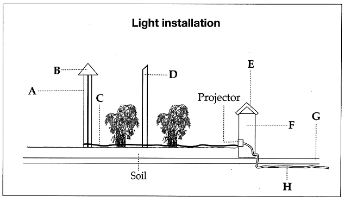
Questions 25-30: Label the diagram below.

Write the correct letter A-H next to questions 25-30.

25        wall

26        electric wire

27        fibre optic cable

28        wooden post

29        glass cap

30        acrylic rod

ieltsmaterial.com - ielts listening practice test

Section 4: Questions 31-40

Questions 31-36: Complete the notes below. Write NO MORE THAN TWO WORDS for each answer.

                                          The Argus system

Developed by Rob Holman in N. Carolina with other researchers.

Research is vital for understanding of 31 ………………….

Matches information from under the water with information from 32 …………….. According to S. Jeffress Williams, useful because can make observations during a 33 …..


                                   Dr Holman's sand collection

Dr H. has samples from every 34 ………………….

Used in teaching students of 35 ………………….

e.g. US East Coast display: grains from south are small, light-coloured and 36……………… in shape

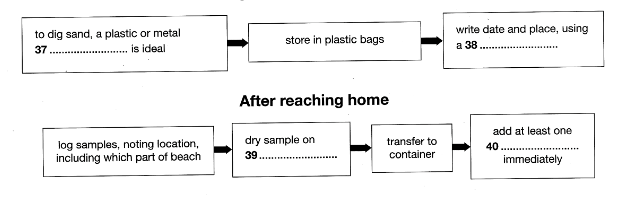
Questions 37-40: Complete the flow-chart below. Write NO MORE THAN THREE WORDS for each answer.

Taking samples when travelling

IElts listening practice test 34

ANSWER KEY FOR IELTS LISTENING PRACTICE TEST 34

  1. 743002
  2. international
  3. (0)6.45 (a.m.) / 6.15 (p.m.) /18.15
  4. thirty / 30
  5. Echo
  6. credit card
  7. seven / 7 days / one / i week / a week
  8. 1,000 / a / one /1 thousand
  9. (his/the) luggage
  10. pavement
    1. A
    2. C
    3. B
    4. C
    5. A
    6. F
    7. A

    18 .  G

    1. E
    2. D

    21/22 B/D (in any order)

    23/24 A/E (in any order)

    1. F
    2. H
    3. C
    4. D
    5. B
    6. A
    7. beach erosion
    8. (fixed) camera
    9. storm
    10. continent
    11. geology (must be spelt correctly)
    12. rounded / round
    13. spoon
    14. permanent marker
    15. (layers of) newspaper
    16. (identification) label


TRANSCRIPT FOR IELTS LISTENING PRACTICE TEST 34

LISTENING SECTION 1

Woman: Hello, how can I help you?

Man: Hi. I'm Carlton Mackay, and you booked me some flights recently, to Australia – and some internal ones?

Woman: Oh, yes, Mr Mackay, I remember you now, of course.

Man: Well, I find I'm going to need car hire while I'm in Sydney after all. I think you said you could recommend a good-value company?

Woman: Yes, that's right. Costwise Cars. They're very good and don't charge lots of extras. They have three offices in the Sydney area, including one office right at the airport.

Man: So, I'll just book it online?

Woman: Yes, you can book online but you should have their phone number too, just in case.

Man: Mm, of course.

Woman: That's 1800 705 639. It's on the website. And you can get a discount if you quote your booking reference from us.

Man: Oh. what's that?

Woman: I mean the one you got from me when we booked your flights. I have it here – 743002.

Man: Oh, thanks. I guess I've got it at home, but I'll write it down again in case. A discount is good. So where exactly is the office? I'll be coming to the domestic terminal from Melbourne.

Woman: It's immediately outside the international terminal.

Man: OK. And, another thing I want to check is, will they be open when I arrive? Or is it just office hours?

Woman: Mm … they open at quarter to seven and close at 6.15 in the evening. So, let's see, you're due to land at ten past six. By the time you've collected your bags and so on, which will take a little while, they won't be open, but if you arrange it in advance, they can wait for you. You do have to pay an extra $30 for that, though.

Man: OK. Well, I'm staying near the airport the first night, so I could go back in the morning and save a day's hire?

Woman: Yes, that'd be better. That'd save you about $50.

Man: Do you know what kind of cars they have?

Woman: Quite a variety, I think. Er, the best value should be under $60 a day with luck. That would be the 'Echo'. I guess.

Man: Sorry?

Woman: E-C-H-O. like when your voice bounces back?

Man: I suppose I have to book online before I leave?

Woman: Mm, that's the best way. Er, they won't deduct any charges until you finish with the car, but they do need vour credit card number when you book and of course they'll want to see your driving licence when you collect. How long will you need it?

Man: I'm in Sydney for seven davs. I'll only actually need to use it on three or four of those days. I hope, but I'll keep it for the whole week. I guess it's going to be a few hundred dollars. Can you suggest anything I can do to keep the cost down?

Woman: Oh, you get quite a big discount if you do less than 1.000 kilometres in the week.

Man: Oh, that's good. I don't suppose I will be driving that far, actually.

Woman: But, oh, yes, the other thing I should mention is the insurance. It's included in the price.

Man: Oh, that is good value then.

Woman: Yes, but what you must remember is that it doesn't cover anything except the car, so you must be careful not to leave anything at all in it when you park because your luggage isn't insured, even if it's out of sight, locked in the boot.

Man: Yeah, well, I think my travel policy will cover that actually.

Woman: Good!

Man: OK. And can I return the car outside office hours? My flight home is very early in the morning. Can I put the keys through the door, or something?

Woman: There's a secure box just outside the office on the pavement. You just drop the keys in there.

Man: Oh, good.

Woman: And one other thing: you should remember to buy petrol before you leave it. If you don't drop the car back with a full tank you get charged to fill it. I recommend you go to a supermarket before you go out to the airport.

Man: Thanks for the tip!

Woman: Not at all. Do call in again if there's anything else I can help with.

Man: I will. Many thanks.

LISTENING SECTION 2

Speaker: Good morning. It's a great pleasure to be here in London and to see so many people interested in working in hotels. We in the International Finest Group of hotels are very proud of our business and we are always on the lookout for quality recruits in every department.

Now, I'm going to outline some of the areas of work where we are currently recruiting and the essential skills or qualifications for them, then I'll run through our recruitment procedure. OK?

At the moment we're looking for a number of people for administrative posts in different parts of the world and also some roles which involve a lot of travelling.

One of our main business streams is hosting special events for other businesses. If you have good communication and organisational skills with a good level of fluency in at least one European and one nonEuropean language. I'd suggest you think about becoming part of the team which sets up these events for all our centres. This would mean being based full-time in our London office. The work ranges from setting up small meetings a few days ahead to organising international conferences two years in advance, so there's plenty of variety. Some of the conferences we run have as many as a thousand delegates, so it's quite challenging.

Then there are some posts available for professionals in the catering field. Chefs we can find; it seems this is a popular career choice in many parts of the world as in the UK these days, in spite of the exacting standards, but people to manage catering departments need more than a love of producing quality food.

We're after really energetic and totally efficient young managers, who already have the relevant business qualifications – no training on the job here – and they must share the team's determination to make everything run smoothly at any time of the day or night.

Or, if you are the type of person who enjoys a challenge, what about becoming one of our relief housekeepers? You'll be a good people person, well organised, and supremely flexible. As well as covering UK holidays, maternity and paternity leave, there will be times when you have to fill a key post when someone's sick, which could be anywhere in our European. Middle Eastern or Far Eastern hotels, so you must be prepared to hop on a plane at five minutes' notice.

The International Finest brand name attracts visitors from all over the world and on all kinds of business and leisure trips. Our swimming pools and gyms need to be run by people with the highest standards of customer service. You don't have to be a great athlete, but smart appearance and a pleasant manner are necessary. A diploma in sports science would be the minimum requirement here.

Lastly, I'd just like to mention that the main London office has another vacancy. Most bookings come online, especially from the Far East for people coming to Europe. If you have fluency and some keyboard skills in. for example. Spanish, or any Far Eastern languages, either having taken a degree, or preferably from having lived and worked overseas, you might be just the person we're looking for to deal with email bookings and queries in the office here. A flexible attitude to working hours is also important as you may have to come in outside normal office hours.

So that's an overview of the kind of jobs, now how to get them!

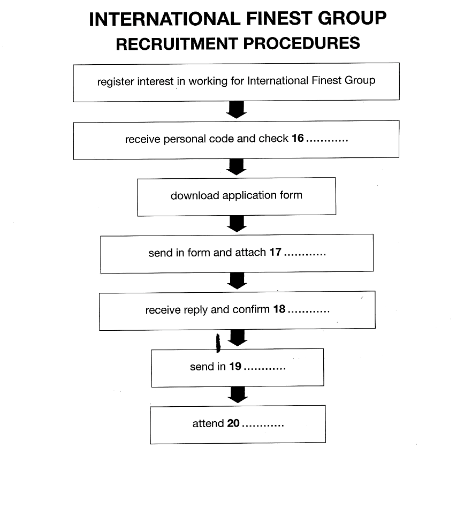
First of all, provided you have a UK work permit, you can go online and register an interest in working for us. By return, you'll receive a unique applicant's code, which is your personal identification number and which we'll use in all communications. Along with that you get access to the Human Resources website, where you should make sure you understand the legal terms and conditions which apply to all our employees. That's also where you can then download the application form – fill it in and send it back along with vour CV. You'll know within 48 hours whether you're being considered as you get an automated response. Sorry if it's a bit impersonal, but at least it's quick. Hopefully, if we like the sound of you, there will be in that automated response a list of times for an initial interview which will take place by telephone during the following week. You confirm by email which of the time slots will suit you. Provided the interview is satisfactory, at that point we'll ask for any evidence of qualifications required, which might be vour degree or diploma certificate or so on. which vou have to send certified copies of. and we contact your referees. The last thing you have to do is you come along and have a look round the International Finest Group head office, get to know some of our team in Human Resources face to face, and participate in a one-day recruitment seminar, which involves a number of group and individual activities along with other potential employees.

Then, with luck, we'll offer you a job! So, I hope you like the sound of joining our organisation.

LISTENING SECTION 3

Tutor: So, let's hear what you're doing for your next project.

Student: I've decided to design a roof garden for a supermarket.

I've been looking at some on the web and I think that a garden on top of a building is the up-and-coming thing.

Tutor: OK. So you’ve done a bit of reading already? What benefits would there be for the client? Why do you think a supermarket chain would be willing to meet ttie expense of construction? You do realise that would be the first thing they raise.

Student: Yes, I know. But I’d explain that In spite of the initially high expense, they would save that much in approximately five years. Well. I'd have to do sums. I mean calculate specifically …

Tutor Yes. how would the saving come about?

Student: Mainly through lower heating and aircon Mis. The extra insulation offered by having a layer of living plants in the soil would make a huge difference

Tutor:  OK But they might feel the expense of maintenance would be an issue. After all, supermarkets don't normally employ gardeners.

Student: What I thought was, if they made it a community garden, rather than a simple lowmaintenance green roof…

Tutor: So there'd be public access?

Student: Oh, yes! Then there'd be a sense of ownership in the local community and people could take responsibility for it, instead of the supermarket paying a commercial company, and it'd really boost their public relations.

Tutor That’s a good point. And have you been looking into how roof gardens are built nowadays?

Student: I’m still exploring that, but if I take advantage of the latest technologies for roof gardens. It shouldn’t be too difficult. But in any case, you have to use lightweight materials.

Tutor But that’s a matter of making the right choices. You can even use quite traditional ones such as wood for the planting areas.

Student: Yes. that’s what I thought. It'll look good and it isn’t too heavy.

Tutor But for the basic construction, the issue you have to address first is the material used between the building and the garden.

Student: You mean the banter fabric, which ensures there’s no chance of rainwater leaking down into the building?

Tutor: Yes, nowadays that is very good, and Quite easily sourced.

Student: Then on the other hand, there's the business of water within the roof garden itself.

Tutor: You mean drainage? That’s an important feature of the construction in any roof design.

Student: Yes. but I think most drainage issues have been well understood lor quite a long time.

Tutor: Ok, but another thing is with plants in an exposed situation, you usually need to find ways to optimise rainfall.

Student: Yes, because rainwater is best for the garden, if you can store it for when it's needed. What I've been looking at are some buildings which use fairtv conventional storage tanks the Kind Eiat have been in use for decades, but have them linkeo to modem automatic watering systems.

Tutor. Sounds complicated!

Student: It's less so In practice than it sounds, I think. I’ve been researching them and actually the Safest ones definitely, work very well and they can be electronically regulated to suit the local microclimate.

Tutor: Mmm, that sounds interesting. You seem to have been doing some thorough research! Make sure you reference all your sources when you write it up.

Student: Yes, sure. Um, there's one more aspect I'd just like to run past you, if there's time? I want to include a light feature in the design.

Tutor: Of course.

Student: I've got a sketch here.

Tutor: Let's have a look then.

Student: Well, I was really impressed by something I saw on a roof in Cornwall and I'd like to design something similar. Um, you have an area of planting, and I'm thinking of installing this lighting in an area filled with low-growing evergreen shrubs.

Tutor: Mmm. You'd have to have lights and things well away from anywhere children might be. But I can see this could be very effective, if a bit complicated. How would it work? On this drawing, this is a section view? You have this low wall on the right?

Student: Yes, that's it. This is just one element and these areas would be repeated all round the planted area. I think this will probably be a wooden wall, using reclaimed timbers, with an angled ceramic top surface.

Tutor: Perhaps even ridge tiles like they use on roofs?

Student: Oh, yes, that'd be just the sort of thing. And that'd make it weatherproof. Um, and then the heavy duty electric wiring comes UP through the floor iust outside the planted area and into the wall. Then it's brought through to a projector low in the side of the wall, and that sends a beam of light along the fibre optic cable.

Tutor: So there's no electricity in the actual lights. The fibre optic goes across the surface of the soil in the planting area.

Student: Yes, that's the beauty of it. The shrubs will soon grow to cover it up, of course, and then the cable goes past a wooden post which is between the shrubs, and can be a support for them as they grow bigger, and then runs up into each element of the installation.

Tutor: So the lioht beam is carried UP to the top of each element and illuminates a kind of conical glass cap? I see! Is that the bit which would glow in the dark?

Student: Yes.

Tutor: And what's the cap supported on? Is it a wall?

Student: No, it's a slender acrylic rod, er. like the stem of a flower or mushroom, which the cable runs up inside of.

Tutor: Well, I'll be interested to see the final drawings.

Student: Thank you! I'm looking forward to putting it all together.

LISTENING SECTION 4

Student: First, I would like to tell you how the Argus computerised photography system has helped marine researchers. Then I shall talk a bit about sand collecting.

Well, Argus is the system Doctor Rob Holman developed when he was working at a research pier on the coast of North Carolina, about 20 years ago.

This pier stretches out over the water, and it’s the longest research pier in the world, with an observation tower on the end of it. The researchers there make precise measurements of how the sand moves about under the waves. This research is critical to the Study of beach erosion in places where the coastline is being worn away.

The Argus system helps to solve the difficulties encountered by these researchers. The system correlates the data from under the water with what Dr Holman gets from his fixed camera, which is mounted above the water on the pier and uses timelapse photography.

Some of Doctor Holman's results have changed the way people understand how sand moves. To quote S. Jeffress Williams, a coastal geologist with the United States Geological Survey, the system is 'a critical piece of new technology' and 'The Argus system allows us to quantify and document visually the changes to the coast on a variety of different time frames. A lot of these take place when there is a storm or at other times when it is difficult to have people out on the beach making observations and taking measurements.'

Up to now Argus installations have been installed in places in Oregon, California, Hawaii, England, the Netherlands, Australia, New Zealand, Spain, Italy and Brazil, as well as in North Carolina.

Now I'd like to introduce Dr Holman's sand collection. He started collecting sand in the 1980s, and he still collects it now, even though he has around a thousand samples. They come from his travels and from geologists and amateurs all over the world – and the collection includes sand from each continent, including Antarctica.

People send him sand in envelopes, plastic bags, paper towels and all sorts! Each is stored in a glass jar, which Dr Holman labels by latitude and longitude of its origin, as well as he can work them out – sometimes the information is a bit sketchy!

Anyway. it's mainly geology students at the university who study his collection, and they can learn a lot from it.

For instance, one set of tubes displays sand from the East Coast of the US. So you can see that the sand gets lighter and finer from north to south. By the time a grain of sand eventually washes up on a beach in Florida at the southern end of that journey, it has, been battered by waves for a long time so the grains are fine and rounded because most of the time sand is not stationary on the beach.

OK, so if you'd like to collect sand and maybe even send some to Dr Holman, how should you go about it? Well, the list of equipment is very short and easy to find, but you should keep a supply when you're travelling, as you never know when you'll come across an interesting sand sample.

One really handy thing for digging sand, especially if it's hard or frozen, is a spoon. It's perfect for that. If you're travelling by air it'll have to be plastic, but metal is preferable, as plastic tends to break. You need something to put the samples in that is dampproof and easy to carry. You can just use plastic bags, but you need to record the location and date on the bag, so you must also have a permanent marker with you, because you can never assume you will remember where you gathered a sample from later on and you don't want it to rub off before you get home.

And that's about all you need in the field to collect sand. When you get home, your samples should be logged in a notebook or computer. You need to note the location and be really specific as to exactly whereabouts on the beach you gathered your sample – low tide mark, under cliff area, etc.

Then, you store your sample. You want to keep everything in good condition and avoid contamination. So first you make absolutely sure that each sample is perfectly dry. You don't need any complicated apparatus for this, you can just air it out on layers of newspaper, which is suitably absorbent. Most people find that's the best way.

Then, lastly, but this is really important, before there can be any chance of confusing this latest sample with another, you put it in a clean small bag or a jar, and you must stick an identification label on straight away. Some people put one inside as well in case the outer label falls off, but that's up to you. Well, that's about all you need to know to get started as a sand collector. Any questions?

Wednesday, September 7, 2016

IELTS Materials and Resources, Get IELTS Tips, Tricks & Practice Test

IELTS Materials and Resources, Get IELTS Tips, Tricks & Practice Test


Underestimate – Word Of The Day For IELTS

Posted: 07 Sep 2016 01:00 AM PDT

Underestimate – Word Of The Day For IELTS Speaking And Writing

Underestimate: (Verb) /ʌndərˈɛstɪmeɪt/

Definition:

To think or guess that something is smaller, cheaper, easier etc than it really is

Synonyms: 

Underate, Undervalue, Belittle

Collocations: 

With adverb: grossly/ never/ seriously underestimate
With noun: underestimate amount/ difficulty/ effect/ extent/ figures/ importance/ mistake/ number/ people/ power/ problem/ strength/ value

Example:

For IELTS Speaking:
“We underestimated how long it would take to get there”
“Never underestimate the power of self-motivation.”

For IELTS Writing:
“In particular, the role of language in the equation has been grossly underestimated.”

Exercise:

Choose the following words to fill in the blank: functional, consisted, underestimate, methodical, involvement, proceed, structural, assess, definition, sections.

  1. The power station should be fully _______________ by the end of the year.
  2. The boys’ suppers for the three days they went camping together _______________ of hamburgers, chocolate bars and potato chips.
  3. The government has said that construction of the factory will not be allowed to _______________ until changes are made to reduce the impact on the environment.
  4. The police have as yet no proof of his _______________ in the robbery.
  5. The building suffered significant _______________ damage during the earthquake.
  6. She is very slow and _______________ in her work, but she certainly does an excellent job.
  7. The company is required to do an _______________ of the environmental damage that would be done to the area before beginning the project.
  8. The island of Cyprus is divided into two _______________: Greek and Turkish.
  9. Research shows that people usually _______________ the amount of time it will take them to learn a second language.
  10. According to anthropologists, there appears to be a universal _______________ of human beauty.

Answer key
1. functional.
2. consisted.
3. proceed.
4. involvement.
5. structural.
6. methodical.
7. assessment.
8. sections.
9. underestimate.
10.definition.

Check out Vocabulary for IELTS Speaking & Writing on IELTS Material website to improve your vocabulary for IELTS and get a high score in IELTS.

Go All Out – Idiom Of The Day For IELTS

Posted: 07 Sep 2016 01:00 AM PDT

Go All Out – Idiom Of The Day For IELTS Speaking.

Definition: 

use a lot of energy and effort to do something

Example:

“Jack is going all out to win the contract – I hope he’ll succeed.”

“She goes all out to attain the scholarship to pursue a higher education.”

“To gain the high IELTS score, I have to go all out.”

Exercise: 

  1. The sentence given below contains an idiom. From the given alternatives, choose the one that best expresses the meaning of this idiom.
    “Messi is going all out to score the first goal for his team.”
    A. Messi scores the goal.
    B. Messi tries to score the goal.
    C. Messi is out of his team.
    D. Messi wants to score the first goal.
  2. Describe the time when you achieve something difficult. Try to use this idiom in your speech. You should say:
    – When did it happen ?
    – What did you do during this time ?
    – How did you achieve it ?
    – And how do you feel when you achieve it ?

IELTS Cue Card Sample 28 – Topic: A country you have not been to yet

Posted: 07 Sep 2016 12:36 AM PDT

IELTS Cue Card for IELTS Speaking Part 2:

Describe a foreign country you would like to go to. ( A country you have not been to yet)
You should say:
what country it is (including where it is in the world)
what this country is like
what people can do in this country
and explain why you would like to go to this country.

BAND 9.0 SAMPLE ANSWER:
There are so many countries that I have not had a chance to go to, but one of those that I would like to visit in my upcoming trip is Myanmar.

It is located in South East Asia. The country is like Thailand 25 years ago, before shopping malls, and fastfood chains expanded in the country. Thus it remains rustic and traditional compared to the modern world.

The people here are said to be friendly; they are willing to go out of their way to show you around and they are very keen on practicing their English skills. Myanmar is famous for its ancient city named Bagan, with more than 3,000 temples which date back to the 11th century. I would particularly love to see the Shwedagon Pagoda. It is considered to be the greatest and most sacred Buddhist temple in the country. The entire structure, which dates back 2,500 years, is covered with hundreds of gold plates.

Since the country has just been opened up to the outside world, it still keeps the originality of its culture. That‟s why I want to go there, to experience the country and the people before globalization changes everything.

USEFUL VOCABULARY AND EXPRESSIONS FOR IELTS SPEAKING:
fastfood chain: [noun] a network of restaurants like McDonald‟s, which you can find in many different places, serving food such as burgers and fries.
rustic: [adjective] simple and typical of the countryside.
Example: The old church in the small village had a rustic appearance.
go out of their way to: [verb phrase] to make a special effort to do something.
Example: The teacher went out of her way to help the students, giving free classes before the exams.
show someone around: [verb phrase] to be a guide for somebody when they visit a new place and to show them what is interesting.
Example: We were shown around the school by one of the students.
sacred: [adjective] connected with a god, and considered to be holy.
Example: In Islam, Mecca is a sacred city.
opened up: [phrasal verb] possible to be visited.
Example: The railways opened up many remote parts of the country.
globalization: [noun] the process by which places become similar to each other all over the world.
Example: You can now buy burgers in fastfood restaurants like McDonald's all over the world, as a result of globalization.

IELTS Listening Practice Test 33

Posted: 06 Sep 2016 11:59 PM PDT

Section 1: Questions 1-10

Questions 1-5: Complete the form below. Write ONE WORD AND/OR A NUMBER for each answer.

        MEGEQUIP CUSTOMER DETAILS

Example                                                     Answer

Order from                                          winter catalogue

Name                                                    1 ………………… Greening

Address                                               2 ………………… York Terrace

Delivery address                               5, York 3 …………………..

Payment method                              4 ………………….. in advance

Reason for discount                        address within the 5 ………………….

Questions 6-10: Complete the table below. Write NO MORE THAN ONE WORD AND/OR A NUMBER for each answer.

                                                            MEGEQUIP CUSTOMER ORDER

Item                         Catalogue no.                         Catalogue section                        Colour                         Delivery notes

desk lamp                     664                                      6 ………………                                slate                             customer will 7 ………………..

chair                              131                                       Home Office                               8 …………….                  our van

filing cabinet               153                                       Commercial                                  grey                            direct from London no

two drawers with                                                                                                                                                 later than 10 ……………….

9 ………………..


Section 2: Questions 11-20

Questions 11 and 12: Choose TWO letters A-E. Which TWO things make the museum unusual?

  1. the guides
  2. the events
  3. the animals
  4. the buildings
  5. the objects

Questions 13 and 14: Choose TWO letters A-E. Which TWO things can visitors do at the museum?

  1. buy home-made bread
  2. ride a horse
  3. ride on a tram
  4. buy copies of original posters
  5. go down a coal mine

Questions 15-20: Label the map below. Write the correct letter A-I next to questions 15-20.

  1. The exhibition centre
  2. The High Street
  3. The farmhouse
  4. The coal mine
  5. The Manor House
  6. The Railway Station
ieltsmaterial.com - ielts listening practice test
ieltsmaterial.com – ielts listening practice test

Section 3: Questions 21-30

Questions 21-26: Which attitude is associated with the following people during the conversation?

Choose SIX answers from the box and write the correct letter, A-H, next to questions 21-26.

Attitudes

  1. amused
  2. critical
  3. forgetful
  4. impatient
  5. polite
  6. retaxed
  7. sympathetic
  8. unrealistic

People

  1. Cressida’s fellow students
  2. Gressida
  3. Ainsley Webb
  4. Dr Erskine
  5. Professor Jenkins
  6. TV news centre staff

Questions 27-30: Choose the correct letter A, B or C.

  1. What was Cressida asked to do at the beginning of her placement?
  2. go out to buy things for the production team
  3. run enands to other parts of the TV news centre
  4. meet visitors and escort them to the studio
  5. What was fortunate for Cressida?
  6. She was familiar with a piece of equipment.
  7. She spent a lot of time in the editing suite.
  8. She was given a chance to interview someone.
  9. What does Cressida fed she needs to improve?
  10. her understanding of business
  11. her organisational skills
  12. her ability to work in a team
  13. What has given her an idea for her final assignment?
  14. a meeting with a public relations professional
  15. seeing a politician speaking to an audience
  16. a disagreement with one of the TV presenters


Section 4: Questions 31-40

Questions 31-40: Complete the table below. Write NO MORE THAN TWO WORDS for each answer.

                           THE HISTORY OF THE ELECTRIC GUITAR

ieltsmaterial

ANSWER

  1. Oskar
  2. 52C
  3. Avenue
  4. cash
  5. city
  6. Living
  7. collect
  8. green
  9. lock
  10. 3rd October / 3 October / October 3

11/12 A/D (in any order)

13/14 C/E (in any order)

  1. E
  2. A
  3. C
  4. H
  5. F       I
  6. B
  7. A
  8. H
  9. B
  10. G
  11. D
  12. E
  13. B
  14. A
  15. B
  16. C
  17. violin
  18. blues
  19. steel / metal
  20. Frying Pan / frying pan
  21. magnets
  22. plastic
  23. solid
  24. mass production
  25. Precision / precision
  26. gold


Activate your Email Subscription to: IELTS Materials and Resources, Get IELTS Tips, Tricks & Practice Test

You received this message because someone requested an email subscription
for syaifursyaify.1945@blogger.com to a FeedBurner feed. If you did not
make this request, please ignore the rest of this message.

Hello there,

You recently requested an email subscription to IELTS Materials and
Resources, Get IELTS Tips, Tricks & Practice Test. We can't wait to send
the updates you want via email, so please click the following link to
activate your subscription immediately:

https://feedburner.google.com/fb/a/mailconfirm?k=tnKBP9R0RN16CiVXdZUlAucc21U

(If the link above does not appear clickable or does not open a browser
window when you click it, copy it and paste it into your web browser's
Location bar.)

--
This message was sent to you by FeedBurner (feedburner.google.com)
You received this message because someone requested a subscription to the
feed, IELTS Materials and Resources, Get IELTS Tips, Tricks & Practice Test.
If you received this in error, please disregard. Do not reply directly to
this email.